How Can They Take Care When Mount Tambora Erups Again
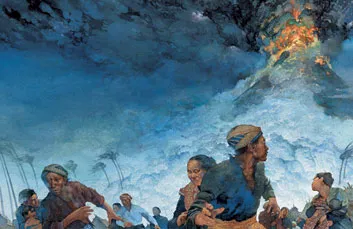
The most destructive explosion on earth in the by 10,000 years was the eruption of an obscure volcano in Indonesia called MountTambora. More than 13,000 anxiety high, Tambora blew up in 1815 and blasted 12 cubic miles of gases, dust and rock into the atmosphere and onto the island of Sumbawa and the surrounding area. Rivers of incandescent ash poured down the mountain's flanks and burned grasslands and forests. The ground shook, sending tsunamis racing across the JavaSea. An estimated 10,000 of the isle's inhabitants died instantly.
It'due south the eruption's far-flung consequences, however, that have near intrigued scholars and scientists. They accept studied how debris from the volcano shrouded and chilled parts of the planet for many months, contributing to crop failure and dearth in North America and epidemics in Europe. Climate experts believe that Tambora was partly responsible for the unseasonable chill that afflicted much of the Northern Hemisphere in 1816, known as the "year without a summer." Tamboran gloom may have even played a part in the cosmos of one of the 19th century's most enduring fictional characters, Dr. Frankenstein's monster.
The eruption of Tambora was ten times more powerful than that of Krakatau, which is 900 miles abroad. But Krakatau is more widely known, partly considering it erupted in 1883, afterwards the invention of the telegraph, which spread the news quickly. Discussion of Tambora traveled no faster than a sailing send, limiting its notoriety. In my 40 years of geological work I had never heard of Tambora until a couple of years ago when I started researching a book on enormous natural disasters.
The more I learned about the eruption of Tambora, the more intrigued I became, convinced that few events in history prove more than dramatically how earth, its temper and its inhabitants are interdependent—an of import matter given concerns such every bit global warming and destruction of the atmosphere's protective ozone layer. So when the gamble arose to visit the volcano while on a trip terminal autumn to Bali and other Spice Islands, I took it.
Republic of indonesia's Directorate of Volcanology and Geologic Hazard Mitigation said that I should not endeavour to climb Tambora—too dangerous. As my guide would subsequently tell me, the proper noun of the mountain ways "gone" in a local language, as in people who have vanished on its slopes. But researchers who have studied the volcano encouraged me. "Is it worth it?" I asked Steve Carey, a volcanologist at the University of Rhode Island, who has fabricated the climb. "Oh, my!" he said. That was all I needed to hear.
Through a travel agent in Bima, a city on Sumbawa, a friend and I hired a guide, a translator, a commuter, a commuter'south mate, a melt and six porters. We filled a van and traveled for hours, weaving amongst horse-fatigued carriages (known locally as Ben-Hurs, after the chariots in the movie) every bit we headed for Tambora's southern slope. The parched terrain was like savanna, covered with tall grasses and only a few trees. A few hours westward of Bima, the huge bulk of Tambora begins to dominate the horizon. Formerly a cone or double-cone, it's at present shaped like a turtle'south shell: the eruption reduced the mountain's height by more 4,000 feet.
We camped a third of the manner up the mountain, and set out at dawn for the meridian, wending around boulders the size of small cars that were tossed similar pebbles from the erupting volcano nearly ii centuries ago. Our guide, Rahim, chose a trail that switched back and forth for almost four miles. The solar day was warm and boiling, the temperature in the 70s. Grasses in places were charred black, burned by hunters in pursuit of deer.
I was excited to approach the site of one of the about of import geological events since human being beings showtime walked the planet. Yet equally I looked up at the mountain, I realized I had some other purpose in heed. The climb was a take a chance to reassure myself that afterward treatment for ii kinds of cancer in the by decade, I could yet chief such a challenge. For me, and then, it was a test. For the 2 porters, striding along in flip-flops, information technology was a pleasant stroll in the country.
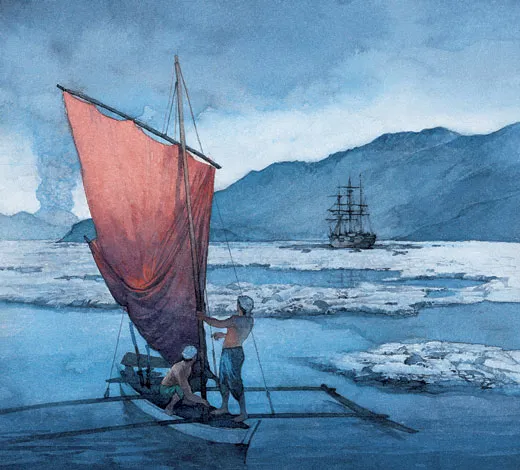
In repose for thousands of years, the volcano began rumbling in early April of 1815. Soldiers hundreds of miles away on Java, thinking they heard cannon burn down, went looking for a boxing. Then, on April 10, came the volcano'south terrible finale: three columns of burn down shot from the mountain, and a plume of smoke and gas reached 25 miles into the atmosphere. Fire-generated winds uprooted copse. Pyroclastic flows, or incandescent ash, poured downward the slopes at more than 100 miles an hour, destroying everything in their paths and boiling and hissing into the sea 25 miles away. Huge floating rafts of pumice trapped ships at harbor.
Throughout the region, ash rained downwardly for weeks. Houses hundreds of miles from the mountain collapsed nether the debris. Sources of fresh water, always scarce, became contaminated. Crops and forests died. All told, it was the deadliest eruption in history, killing an estimated xc,000 people on Sumbawa and neighboring Lombok, most of them past starvation. The major eruptions concluded in mid-July, only Tambora's ejecta would have profound, enduring effects. Cracking quantities of sulfurous gas from the volcano mixed with h2o vapor in the air. Propelled by stratospheric winds, a haze of sulfuric acid aerosol, ash and dust circled the earth and blocked sunlight.
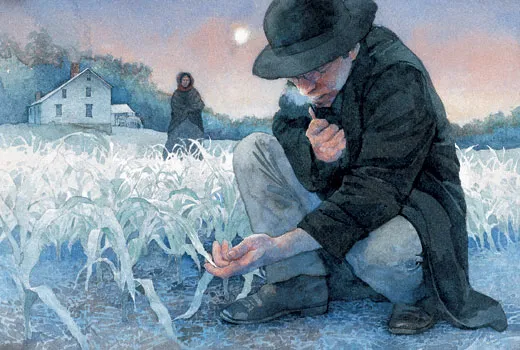
In Prc and Tibet, unseasonably common cold conditions killed trees, rice, and fifty-fifty h2o buffalo. Floods ruined surviving crops. In the northeastern Usa, the weather in mid-May of 1816 turned "backward," equally locals put information technology, with summertime frost striking New England and as far due south as Virginia. "In June . . . another snow came and folk went sleighing," Pharaoh Chesney, of Virginia, would subsequently remember. "On July four, water froze in cisterns and snowfall fell again, with Independence 24-hour interval celebrants moving inside churches where hearth fires warmed things a mite." Thomas Jefferson, having retired to Monticello after completing his 2d term as President, had such a poor corn ingather that yr that he applied for a $1,000 loan.
Declining crops and rising prices in 1815 and 1816 threatened American farmers. Odd as it may seem, the settling of the American heartland was patently shaped past the eruption of a volcano 10,000 miles away. Thousands left New England for what they hoped would be a more hospitable climate west of the Ohio River. Partly every bit a outcome of such migration, Indiana became a state in 1816 and Illinois in 1818.
Climate experts say that 1816 wasn't the coldest year on tape, but the long cold snap that coincided with the June-to-September growing flavour was a hardship. "The summer of 1816 marked the indicate at which many New England farmers who had weighed the advantages of going westward made up their minds to practice then," the oceanographer Henry Stommel and his wife, Elizabeth, wrote in their 1983 book about Tambora's global furnishings, Volcano Atmospheric condition. If the ruinous conditions wasn't the only reason for the emigration, they note, it played a major part. They cite historian L. D. Stillwell, who estimated that twice the usual number of people left Vermont in 1816 and 1817—a loss of some 10,000 to 15,000 people, erasing seven years of growth in the Light-green Mountain State.
In Europe and Great Great britain, far more the usual corporeality of rain fell in the summer of 1816. It rained nonstop in Ireland for eight weeks. The potato crop failed. Famine ensued. The widespread failure of corn and wheat crops in Europe and Great Britain led to what historian John D. Postal service has called "the last great subsistence crisis in the western earth." Afterward hunger came disease. Typhus broke out in Ireland belatedly in 1816, killing thousands, and over the next couple of years spread through the British Isles.
Researchers today are conscientious not to blame every misery of those years on the Tambora eruption, because by 1815 a cooling tendency was already nether way. Also, there's little evidence that the eruption affected climate in the Southern Hemisphere. In much of the Northern Hemisphere, though, there prevailed "rather sudden and oftentimes extreme changes in surface weather subsequently the eruption of Tambora, lasting from one to three years," according to a 1992 collection of scientific studies titled The Year Without a Summer?: Earth Climate in 1816.
In Switzerland, the damp and dark twelvemonth of 1816 stimulated Gothic imaginings that nonetheless entertain us. Vacationing nigh Lake Geneva that summer, Lord Byron, Percy Bysshe Shelley and his presently-to-be wife, Mary Wollstonecraft, and some friends saturday out a June storm reading a collection of German ghost stories. The mood was captured in Byron's "Darkness," a narrative verse form set when the "bright sun was extinguish'd" and "Forenoon came and went—and came, and brought no mean solar day." He challenged his companions to write their own macabre stories. John Polidori wrote The Vampyre, and the future Mary Shelley, who would later call back that inspirational season equally "cold and rainy," began work on her novel, Frankenstein, virtually a well-significant scientist who creates a nameless monster from body parts and brings it to life by a jolt of laboratory-harnessed lightning.
For Mary Shelley, Frankenstein was primarily an entertainment to "quicken the beatings of the heart," she wrote, merely it has also long served equally a alarm non to overlook the consequences of humanity'southward tampering with nature. Fittingly, possibly, the eruption that probably influenced the invention of that morality tale has, nearly ii centuries later, taught me a like lesson about the dangers of humanity'southward fouling our ain temper.
After several hours of difficult, wearisome climbing, during which I stopped oftentimes to beverage water and catch my jiff, we reached the precipice that is the southern rim of Tambora. I stared in silent awe down the volcano's throat. Clouds on the far side of the great crater formed and reformed in the lite breeze. A solitary raptor sailed the currents and updrafts.
Three thousand anxiety deep and more three miles across, the crater was as arid equally it was vast, with non a single blade of grass in its basin. Enormous piles of rubble, or scree, lay at the base of the steep crater walls. The floor was brown, flat and dry, with no trace of the lake that is said to collect there sometimes. Occasional whiffs of sulfurous gases warned us that Tambora is notwithstanding active.
We lingered at the rim for a couple of hours, talking quietly and shaking our heads at the immensity before us. I tried to conceive of the unimaginable racket and ability of the eruption, which volcanologists have classified as "super-colossal." I would accept liked to stay there much longer. When information technology was time to go, Rahim, knowing that I would probably never return, suggested I say expert-bye to Tambora, and I did. He stood at the rim, whispering a prayer to the spirits of the mountain upon whose flanks he has lived most of his life. Then we fabricated our descent.
Looking into that crater, and having familiarized myself with others' inquiry on the consequences of the eruption, I saw as if for the first time how the planet and its life-forms are linked. The cloth that it ejected into the atmosphere perturbed climate, destroyed crops, spurred disease, made some people go hungry and others migrate. Tambora also opened my eyes to the idea that what human beings put into the atmosphere may have profound impacts. Interestingly, scientists who study global climate trends apply Tambora as a benchmark, identifying the period 1815 to 1816 in ice cores from Greenland and Antarctica by their unusually high sulfur content—signature of a keen upheaval long ago and a world away.
Source: https://www.smithsonianmag.com/history/blast-from-the-past-65102374/
0 Response to "How Can They Take Care When Mount Tambora Erups Again"
Post a Comment