what is the closest star to the sun how far away is betelgeuse
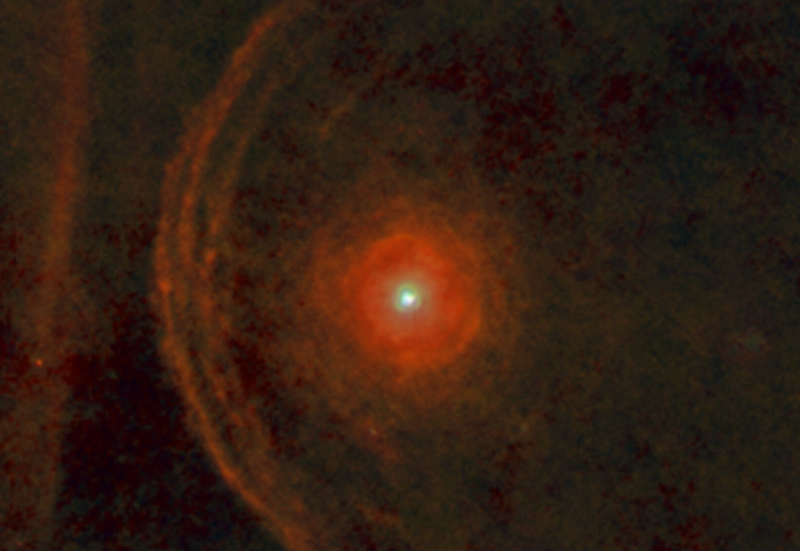
Betelgeuse is a supergiant star
Betelgeuse is the nearest red supergiant star to World. Anytime it'll explode as a supernova, but when? Just over a twelvemonth ago, in late 2019, Betelgeuse sparked excitement around the world when it began dimming noticeably. The strange dimming of Betelgeuse caused some to believe the large event was close at hand. Simply Betelgeuse hasn't exploded yet. This highly noticeable star in the constellation Orion the Hunter has since regained brightness, dimmed over again, and brightened again, apparently now returning to a less agile state. Clearly, though, more than dimming could happen at any time.
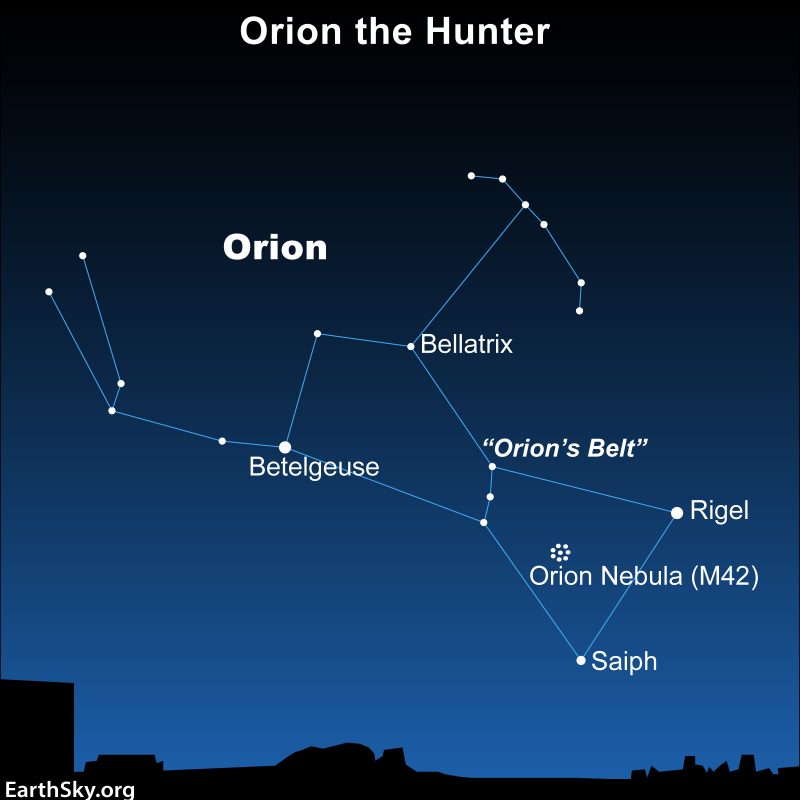
Offset watching Betelgeuse now, and you lot can keep an eye out for yourself. It's easy to spot, as the second-brightest star in Orion, mark the Hunter's right shoulder. Betelgeuse shines with a somber hue. It's well-placed for viewing in the evening heaven during the first couple of months of every year.
Why did Betelgeuse all of a sudden dim?
A statement from the Harvard Smithsonian Center for Astrophysics, released in August 2020, explained:
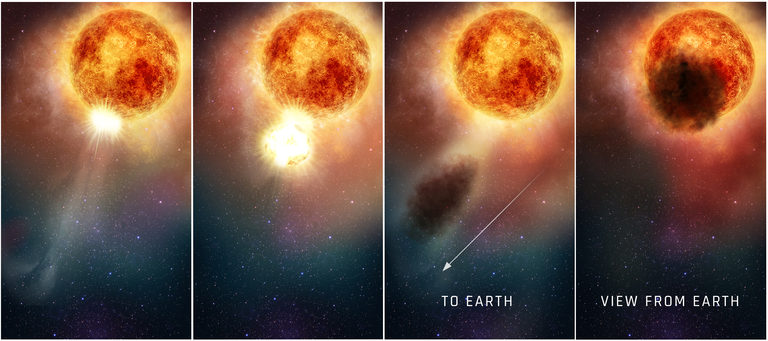
Between October and November 2019, Hubble Space Telescope observed dense, heated material moving outward through the star'due south extended temper at 200,000 miles per 60 minutes. The post-obit calendar month, several ground-based telescopes observed a decrease in brightness in Betelgeuse's southern hemisphere, as if something was blocking light in this region of the star. By February 2020, the star had lost more than two-thirds of its brilliance, a dimming visible fifty-fifty to the unaided eye, creating fizz that the star might be going supernova.
Astronomers farther explained:
With Hubble, we had previously observed hot convection cells on the surface of Betelgeuse and in the autumn of 2019 we discovered a large amount of dumbo hot gas moving outwards through Betelgeuse's extended atmosphere. We remember this gas cooled down millions of miles exterior the star to form the grit that blocked the southern office of the star imaged in January and February.
The fabric was two to four times more than luminous than the star's normal brightness. And and then, about a calendar month later on the south part of Betelgeuse dimmed conspicuously equally the star grew fainter.
We recall it possible that a dark cloud resulted from the outflow that Hubble detected.
So the strange dimming of Betelgeuse was patently caused by a deject of hot gas, released by the star, that temporarily blocked some of the star'due south lite.
Betelgeuse will explode … someday
Betelgeuse may lie as close as 430 lite-years from Globe (although some estimates place it farther away; determining distances to reddish supergiant stars such every bit Betelgeuse is a vexing trouble in astronomy). Betelgeuse is far away, all the same it's one of the brightest stars in Earth'south sky because it's intrinsically very bright, some 100,000 times brighter than our own sun.
Such brilliance comes at a price. Betelgeuse's enormous energy requires that its fuel be expended quickly, which hastens the finish of its life. Someday "soon" the star will run out of fuel, collapse under its own weight, and then rebound in a spectacular supernova explosion. When this happens, Betelgeuse will brighten enormously for a few weeks or months, perhaps becoming as bright as the full moon, and be visible in broad daylight.
When will it happen? Probably not in our lifetimes. But, in fact, no one really knows. It could exist tomorrow or a 1000000 years in the future.
Will the Betelgeuse supernova destroy Globe?
No. Whenever Betelgeuse does blow upward, our planet Earth is too far away for this explosion to damage, much less destroy, life on Earth. Astrophysicists say nosotros'd take to be inside 50 light-years of a supernova for it to harm usa. Betelgeuse is nearly 10 times this distance.
Instead, anyone live on Earth when it happens volition be treated to an amazingly beautiful sight in the nighttime sky – a very, very, very bright star.
Astronomers will exist lucky to have Betelgeuse as close as information technology is and then that they tin can study the star post-supernova.
Betelgeuse in the night heaven
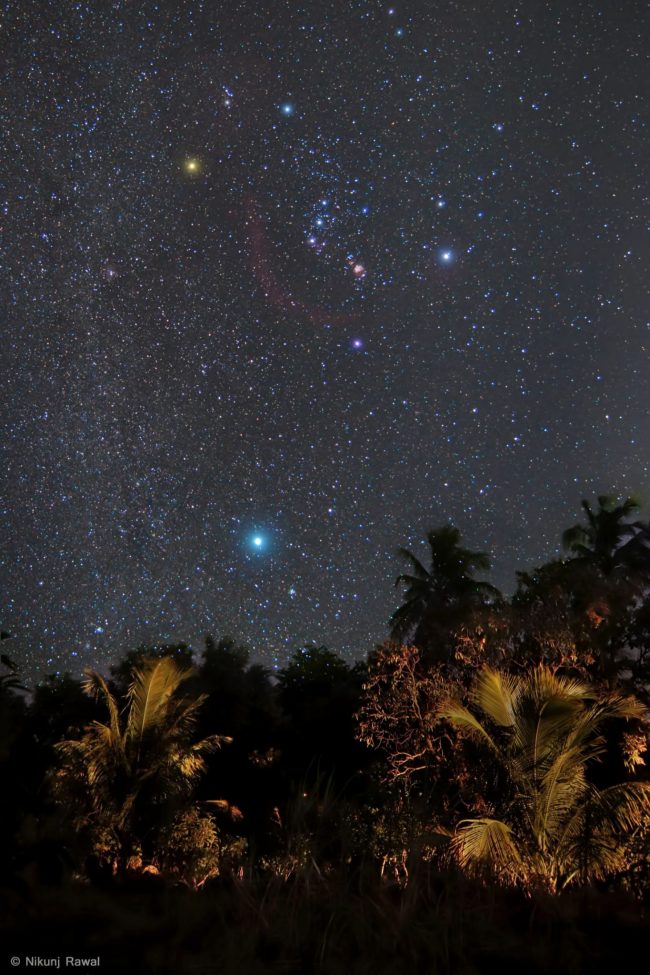
At mid-northern latitudes, around the kickoff of every year, Betelgeuse rises around sunset. The star is well placed for viewing on January and February evenings.
By the beginning of March, this star is due southward in early evening. By mid-May, it can exist glimpsed briefly in the west after sunset. Betelgeuse is traveling behind the sunday in early on summer, simply it returns to the east before dawn by most mid-July.
The star Betelgeuse has a distinctive color: somber orange-ruby-red. Information technology'due south platonic for convincing non-believers that stars do, in fact, come in colors.
Stars designated as Alpha are typically brightest in their constellations. But Betelgeuse is Blastoff Orionis, despite the fact that it's fainter than Orion'southward other bright star, Rigel.
Betelgeuse is the 10th brightest star in the sky overall, and information technology'due south the seventh brightest star visible from most of the U.S., Canada, Europe and the majority of the Northern Hemisphere.

Betelgeuse in popular culture, history and mythology
Call back the movie Beetlejuice? This star's name is similar.
The proper names of many vivid stars are Standard arabic in origin. This fact reflects the say-so of Arabic astronomers and astrologers during Europe'south Nighttime Ages. The name Betelgeuse is derived from an Arabic phrase that is usually translated every bit The Armpit of the Giant. Of course the Giant refers to Orion, but – rather than an armpit – some authors see Betelgeuse equally representing a hand or sometimes a shoulder. While it is non entirely clear what the name ways, in any event, Betelgeuse marks the correct shoulder of Orion in many quondam star maps.
In the ancient myths, Orion is nearly often associated with a giant, a warrior, a hunter, a god or another anthropomorphic or beast figure, so information technology is not surprising that well-nigh depictions of Betelgeuse accept an anatomical connection. The Sanskrit name signified an arm, likewise, for example, although it likely was really the leg of a stag. In parts of Brazil, Betelgeuse was seen as the hind leg of a cayman (crocodilian) or the foreleg of a turtle. On the other hand, in ancient Japan, Betelgeuse was considered to be office of the rim of a ceremonial drum. In Peru, it was one of 4 vultures about to devour a criminal.
The position of Betelgeuse is RA 05h 55m 10.3053s, dec +07° 24′ 25.4″.

Bottom line: Betelgeuse is due to explode as a supernova someday, although maybe non soon on a human timescale. When it does explode, it'll be bright enough from our earthly vantage bespeak to shine during the twenty-four hours. But it'south far plenty away that Earth won't be in danger.
Source: https://earthsky.org/brightest-stars/betelgeuse-will-explode-someday/
0 Response to "what is the closest star to the sun how far away is betelgeuse"
Post a Comment